


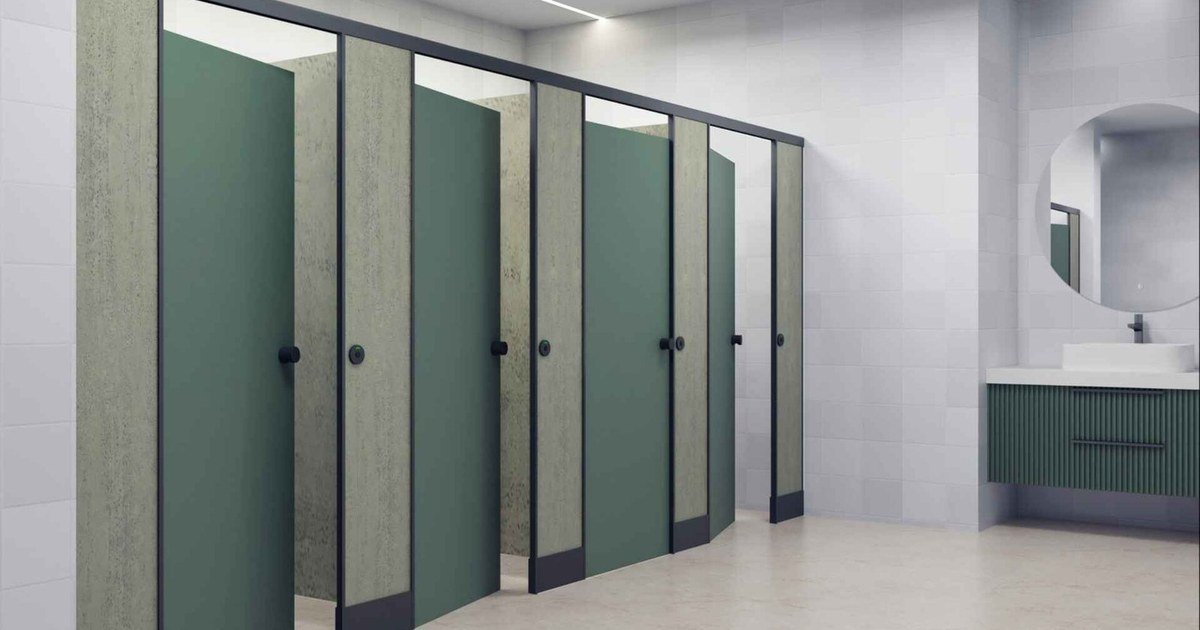
Choosing between toilet cubicle manufacturers is one of the last decisions on a commercial project, yet it shapes how the washroom looks and works for years. Many toilet cubicle manufacturers offer similar photos and similar promises. The real differences sit in the specification: panel grade, hardware, installation method and service after handover. This guide gives builders, architects and facility teams working across commercial sectors a practical way to compare toilet cubicle suppliers. It ends with a checklist you can use on your next enquiry.
Key Takeaways
- Compare toilet cubicle manufacturers on written specifications, not on brochures: panel grade, density, thickness, standards and hardware grade.
- A good toilet cubicle partition supplier also manages site readiness, installation and spares, so ask about the whole process.
- Ask for proof such as case studies and site visits, and judge every quote against the same specification.
Manufacturer, Supplier or Installer: Who Does What
The words manufacturer, supplier and installer are often used as if they mean the same thing. They do not. Knowing the difference helps you ask the right questions and compare quotes fairly.
The laminate maker
Most commercial cubicles today use compact laminate panels. These are made by specialist laminate companies in large presses. The panel maker controls the core material, the density and the surface finish. Brands such as DEBO and Stylam make the panels named in the Super Creations specification.
The panel brand matters because it sets the base quality of the whole system. Density, core colour, surface finish and test certificates all come from the laminate maker. Toilet cubicle manufacturers that name their panel brands openly make it easy for you to check those details. Be cautious with any quote that only says compact board, with no brand or grade.
The cubicle manufacturer and supplier
Toilet cubicle manufacturers turn those panels into a working system. They cut doors, pilasters and dividers to size, add the frame and hardware, and design the layout for your floor plan. This is where most of the engineering happens. Two toilet cubicle manufacturers can start with the same panel and still deliver very different results.
The installer
Installation turns parts into a finished washroom. Some toilet cubicle suppliers only deliver materials and leave fixing to a local contractor. Others supply and install with their own trained teams. For a busy commercial site, a single company that designs, supplies and installs is usually easier to manage, because one team owns the result.
Super Creations has worked this way since 2000. The company plans, supplies and installs complete cubicle systems from its Hyderabad head office and branches in Chennai and Bengaluru. You can read more about how we work in our story and team.
The difference also matters when something goes wrong. If one company supplies panels, another fabricates and a third installs, each can blame the others for a misaligned door or a loose hinge. When toilet cubicle manufacturers also install, responsibility is clear. Ask all toilet cubicle suppliers to state in writing which parts of the work they will do themselves and which they will subcontract. This one question removes much of the risk from a cubicle package.
Start With the Specification, Not the Brochure
The most reliable way to compare toilet cubicle manufacturers is to put the same written specification in front of each one. Photos show colour and style. A specification shows what you are actually buying. If two quotes describe different panels or different hardware, the cheaper one is rarely a like for like saving.
Panel grade and density
Ask what the panels are made of. In the Super Creations specification, panels are solid grade compact laminate made of phenolic resins under high pressure and temperature, with a density above 1,400 kg per cubic metre. This kind of high pressure laminate is chosen for wet, busy washrooms because it resists water, scratches and impact.
The same specification states that water immersion should raise panel weight by less than 0.6 to 0.8 percent. Numbers like these let you compare toilet cubicle suppliers objectively. If a quote cannot state density or water absorption, ask for the laminate data sheet.
Write these values into your tender before you invite prices. When every bidder must confirm the same panel grade, density and thickness, toilet cubicle manufacturers compete on service and price rather than on hidden material changes. Ask bidders to name the laminate brand and to submit a sample of the actual panel. A sample shows the core colour, edge finish and surface texture far better than a catalogue page.
Thickness and sizes
Standard cubicles in the Super Creations range use 12 mm panels. The standard size is 900 to 1,200 mm wide, 1,500 mm deep and 2,000 mm high, with a door of 600 mm by 1,830 mm. Toilet cubicle manufacturers should confirm these figures on drawings and explain any custom sizes your layout needs.
Standards and certificates to ask about
The panel specification refers to IS 2046 and EN 438, and to the BS 476 fire standard. IS standards are published by the Bureau of Indian Standards. The specification also asks for a GREENGUARD certificate, which relates to indoor air emissions. These certificates belong to the laminate, so ask the toilet cubicle manufacturer for the panel maker’s test reports rather than a general claim.
Fire performance is a common question from consultants and approving authorities. Ask which fire test the panels were tested to, when the report was issued and which product thickness it covers. A report for one panel thickness does not automatically cover another. Keep copies of every certificate with your project file, so they are ready when the building is inspected or handed over.
Hardware Grade Decides How Long Cubicles Last
Panels rarely fail first. Hinges, locks, legs and channels take the daily wear. That makes hardware one of the clearest differences between toilet cubicle manufacturers, and one of the easiest places to cut cost without the buyer noticing.
Stainless steel hardware
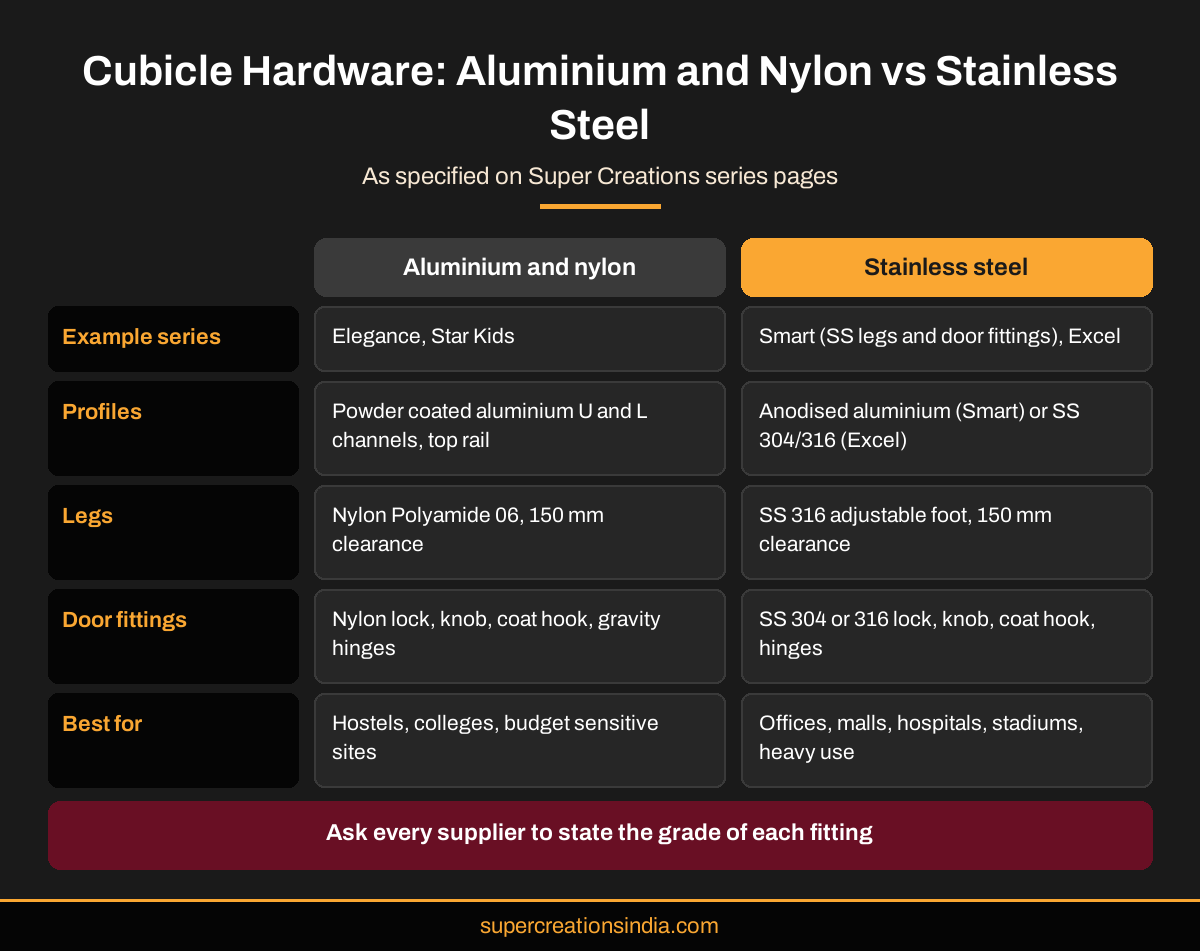
Stainless steel resists rust in damp washrooms. Stainless steel grade 316 has better corrosion resistance than grade 304, which is why it is often used where water and cleaning chemicals are constant. In the Smart Series, the adjustable legs are SS 316 and the lock, door knob, coat hook and hinges are SS 304. The Excel Series uses SS 304 or 316 for channels, top rail and door hardware, for stadiums, clubhouses and other very busy sites.
Location also affects the choice. Washrooms near the coast, in swimming areas or in buildings cleaned with strong chemicals face harsher conditions than a dry office. In these places, ask toilet cubicle manufacturers whether every exposed fitting, including screws and legs, is stainless steel, and which grade. A single cheaper part can rust and spoil an otherwise strong system.
Aluminium and nylon hardware
Lower budget systems use aluminium profiles with nylon fittings. The Elegance Series uses powder coated aluminium channels and Nylon Polyamide 06 legs, locks, knobs and gravity hinges. This suits hostels, colleges and other sites where cost matters and the hardware is easy to replace. Ask each toilet cubicle manufacturer to list the grade of every fitting, not just the frame.
You can check hardware quality on a sample cubicle in a few minutes. Open and close the door many times and listen for noise. Look at how the hinge is fixed to the panel and whether screws are stainless steel. Press on the legs and see whether the pilaster moves. Toilet cubicle manufacturers that are proud of their hardware will be happy to show you these details in person.
Small details matter too. Look for door noise reduction tape, chamfered visible edges and one continuous divider panel without joints. These are written into the Super Creations specification, and they make a visible difference to the finished washroom.
Match the Range to Your Budget and Design
Good toilet cubicle manufacturers offer more than one system, so you can match quality to each washroom instead of using one product everywhere. Super Creations lists 14 cubicle series on its products page, from economical models to designer systems.
- Budget and everyday use: Elegance and Smart, with anodised or powder coated aluminium frames.
- Heavy use and premium sites: Excel, with stainless steel hardware and a flush facade.
- Extra privacy for showers and change rooms: the Box Up versions, with a closed bottom section.
- Designer washrooms: Prominence, which is floor free, and Eminence, which is suspended from the false ceiling.
- Smart indicators: Vogue, with an LED occupancy light in the mid pilaster, and Ellipse, with integrated LED lights.
- Children: Super Kids and Star Kids, with CNC cut curves and bright colours.
- Renovation: TD Series, which replaces doors between existing brick walls.
Colour and finish also matter for design teams. Super Creations offers more than 300 shades. Ask any toilet cubicle partition supplier for physical samples, because laminate colours look different under washroom lighting. For a general introduction to cubicle types, see our guide to what toilet cubicles are.
A useful habit is to choose a series per washroom type. A school might use a durable stainless steel system in senior blocks and a colourful, lower system for young children. That is exactly what one school in Hyderabad did, as the next sections show.
Think about lifetime cost as well as purchase price. A cheaper system may suit a staff washroom used a few times a day. A mall, airport or school washroom may be used hundreds of times daily, and there a stronger series often costs less over its life. Ask toilet cubicle manufacturers which series they would recommend for each washroom and why. A clear, reasoned answer is a good sign that the supplier understands how cubicles are actually used.
Installation Capability and Site Readiness
A strong product can still fail on site if installation is rushed or starts too early. Before you sign, ask how the toilet cubicle manufacturer plans, installs and hands over the work.
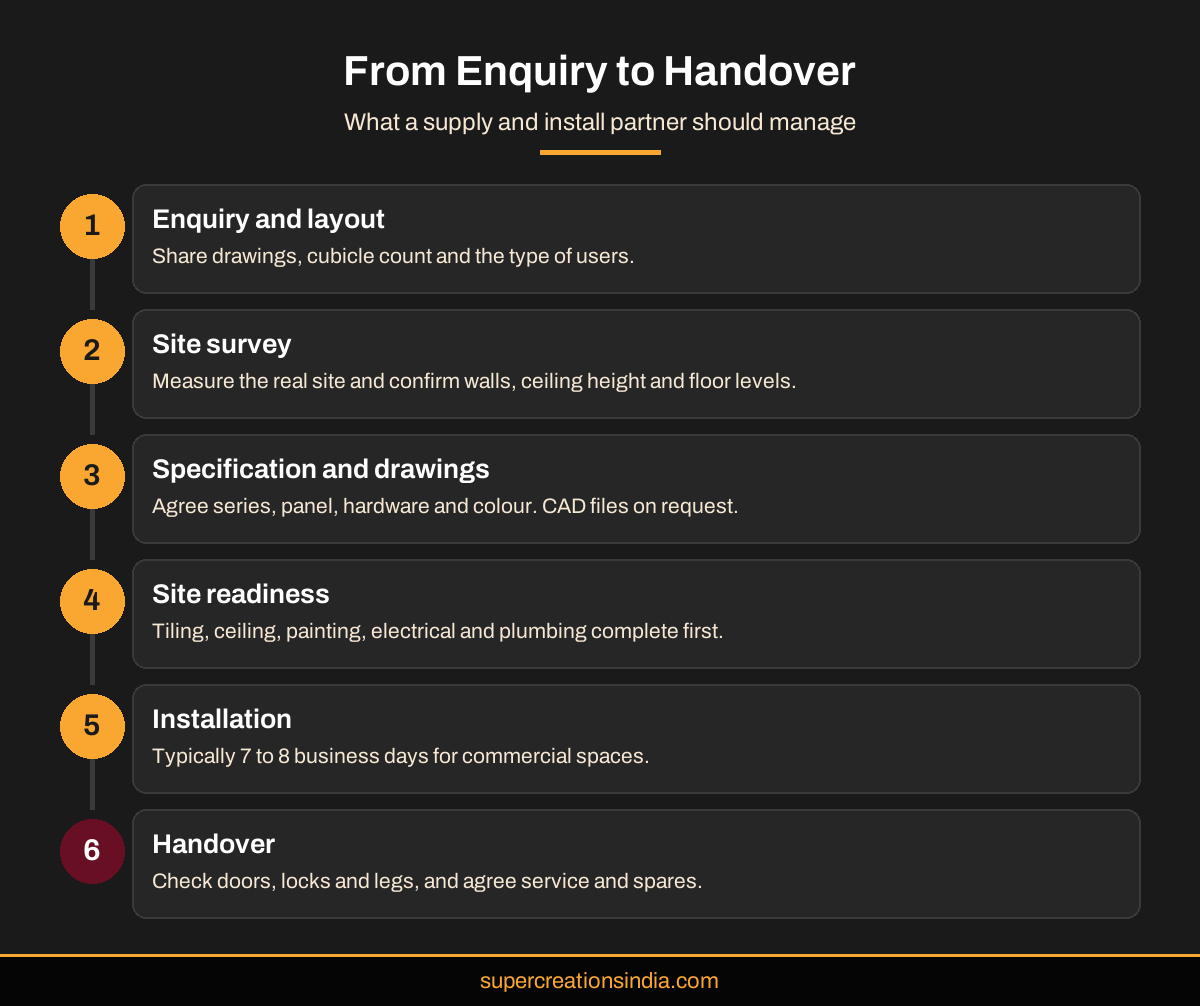
Site readiness is the first check. The Super Creations series pages state that work starts after wall tiling, floor tiling, ceiling, grouting, painting, electrical work and plumbing are complete. Most standard series need a minimum ceiling height of 8 ft. Pilasters stand on adjustable legs of 100 to 150 mm and are fixed at the top to a 50 mm wide top rail.
Layout is the second check. Systems can be fixed wall to wall, or wall to panel when only one side wall exists. Where there is no brick wall, an aluminium L channel connected to the top rail closes the corner. Ask the toilet cubicle partition supplier to show these details on a drawing before fabrication starts.
Time is the third check. The Super Creations FAQ states that typical installation for toilet partitions in commercial spaces is 7 to 8 business days. Your own timeline depends on cubicle count and site access, so ask for a schedule in writing.
Finally, ask who installs. A restroom cubicle supplier for builders and architects should provide trained installers, not just a delivery. Request a site survey visit before the order, so measurements come from your building rather than old drawings.
Coordination with other trades is the last check. Cubicles are fixed to finished walls and floors, so tiling and plumbing must be in their final positions. Toilet cubicle manufacturers should share fixing points early, so plumbers do not place pipes where legs or brackets will go. A short coordination meeting between the main contractor and the cubicle team often saves days of rework.
Plan delivery and storage too. Compact laminate panels are heavy and their faces can be scratched if they are stacked carelessly. Agree where materials will be stored, who will move them and when the washroom will be handed to the cubicle team. On multi floor projects, ask toilet cubicle manufacturers to phase delivery floor by floor, so panels are not left in busy corridors.
Proof to Ask For Before You Shortlist
All toilet cubicle suppliers say they are reliable. Proof turns that claim into evidence you can check. Ask each toilet cubicle manufacturer on your shortlist for the same three things: published case studies, references from similar projects and a site you can visit.
Case studies should name the series used, the number of cubicles and the result. For example, the Celestiia School case study describes 21 Smart Series HPL cubicles for senior washrooms and 8 colourful Excel Box Up cubicles for juniors, 29 cubicles in total. The Narayana College project used 36 Smart Series cubicles in Gothic Grey for a high traffic student washroom.
References should come from projects like yours. A hospital buyer should speak to another hospital. A developer should ask about repeat work across several buildings. Ask how the supplier handled a problem, not just whether the project went well.
When you call a reference, keep the questions specific. Did the cubicles arrive on time? Did the installation team leave the site clean? Were any parts missing or damaged, and how fast were they replaced? How do the doors and locks perform today? Honest answers to these questions separate dependable toilet cubicle manufacturers from those that only look good on paper.
A site visit shows how cubicles look after real use. Check door alignment, hinge action, leg corrosion and edge wear. A washroom that still looks good after heavy use tells you more than any showroom.
Scale is part of the proof. A restroom cubicle supplier for builders and architects that has completed projects with 30 or 40 cubicles, like the two school projects above, has shown it can plan and deliver at that size. If your project is larger, ask for an example of similar size, and ask how the team would staff the installation.
Ask also for drawings. Toilet cubicle manufacturers that work with architects should provide detailed drawings, and Super Creations offers CAD files on request for each series. Drawings make approval faster and reduce changes on site.
Service After Handover
A washroom is used thousands of times a year. Hinges loosen, locks wear and sometimes a door is damaged. The way toilet cubicle manufacturers handle these moments is part of what you are buying.
Ask how spare parts are supplied and how quickly a technician can visit. Hardware replacement is listed among the reasons to choose Super Creations on its website, which makes it a fair question for all the toilet cubicle suppliers you compare.
Ask for warranty terms in writing, and check what they cover. Panel defects, laminate peeling and hardware corrosion may each be treated differently. Make sure the warranty names the company that will honour it.
Large buildings benefit from a small stock of spares. Ask the supplier to hand over a few spare hinges, locks and knobs that match the installed hardware. Facility teams can then fix minor issues the same day. Toilet cubicle manufacturers that offer this usually understand how washrooms are maintained after the builders leave.
Cleaning advice is another sign of a careful toilet cubicle partition supplier. Compact laminate partitions should be cleaned with mild detergent, warm water and a soft cloth, avoiding harsh chemicals and abrasive pads. Facility teams who follow this routine keep panels looking new for longer.
Use the handover visit well. Walk the washroom with the installer and test every door, lock and indicator. Check that legs are level and that top rails are firmly fixed. Note any defects in writing and agree a date to fix them. Good toilet cubicle manufacturers welcome this kind of inspection, because it protects both sides and sets a clear starting point for service.
A Checklist for Comparing Toilet Cubicle Manufacturers
Use the checklist below whenever you send an enquiry. Send the same questions to all toilet cubicle suppliers and compare the written answers side by side. This turns a confusing set of quotes into a fair decision.
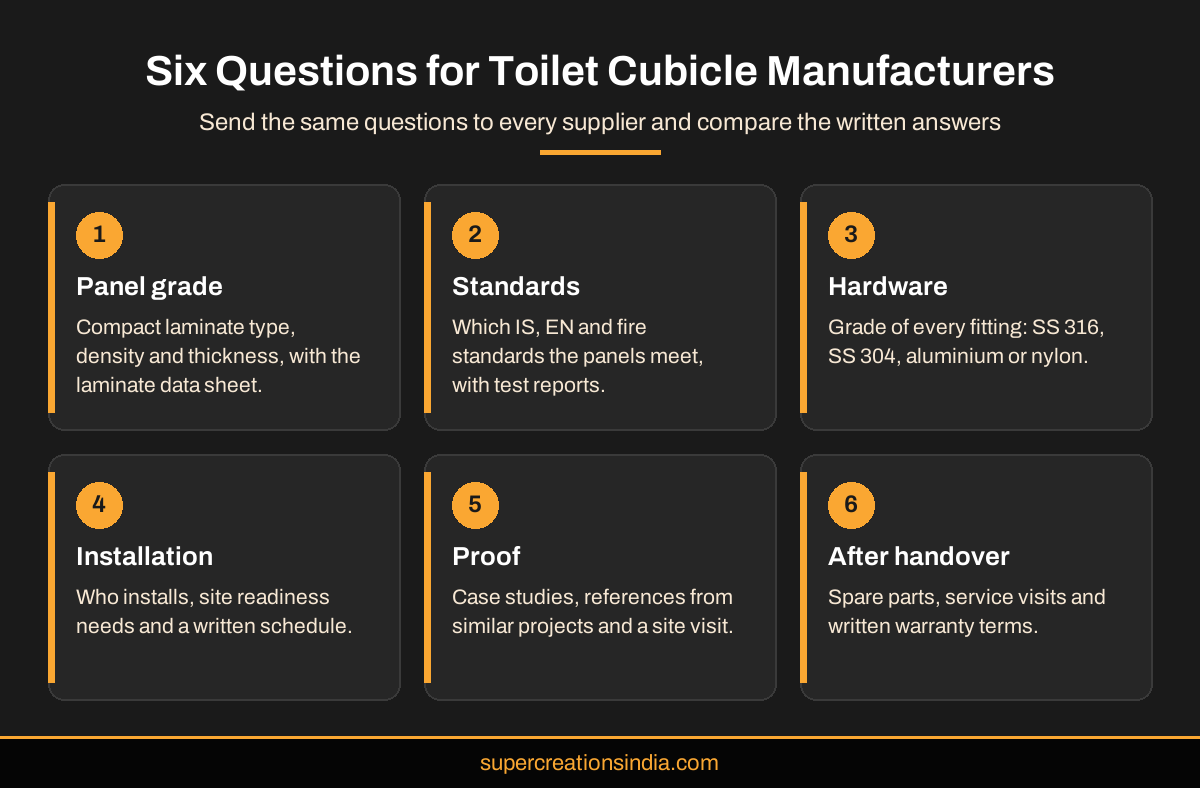
Put your answers into the bill of quantities or tender document. When the specification is fixed in writing, every compact laminate toilet cubicle supplier quotes for the same product. The cheapest valid quote is then a real saving, not a hidden downgrade.
Finally, involve toilet cubicle suppliers early. A good partner will review your layout, suggest the right series for each washroom and flag site issues before they cause delays. That early advice is often worth more than a small difference in price.
A simple scoring method helps when several toilet cubicle manufacturers quote. Give each supplier a score out of five for panel grade, hardware, installation capability, proof and service. Weight the scores to match your project. A hospital may weight hygiene and hardware higher, while a developer may weight delivery and repeat capacity. The highest total, not the lowest price alone, usually points to the best partner.
Watch for warning signs as you compare. Be careful if toilet cubicle manufacturers will not name the laminate brand, cannot share a data sheet or avoid stating hardware grades. Be careful too if the quote leaves out installation, or if no one visits the site before fabrication. These gaps often appear later as extra costs, delays or early repairs.
Keep the shortlist short. Three well chosen toilet cubicle suppliers are easier to compare in depth than ten. Spend the saved time on site visits and reference calls, because those steps reveal the most about how a partner really works.
Conclusion
The best toilet cubicle manufacturers are easy to compare once you know what to ask. Fix the panel grade, thickness, standards and hardware in writing. Check installation capability and site readiness. Ask for case studies, references and a site visit, and agree service terms before you order. Super Creations has supplied and installed cubicle systems since 2000 across 14 series for schools, hospitals, offices and public spaces. To discuss your project, request a quote and share your drawings with our team.